Pearson Edexcel · A-Level · English Literature
Course version: 9ET0 · Version from Sept 2015
Poetry – Section A: Post-2000 Poetry – Poems of the Decade: An Anthology…
Full specification wording
Component 3: Poetry – Section A: Post-2000 Poetry – Poems of the Decade: An Anthology of the Forward Books of Poetry 2002–2011: Giuseppe Roderick Ford
The poem explores the dark, magical realist tale of a captive mermaid being killed and eaten during World War II in Sicily.
Checked against the Pearson Edexcel 9ET0 specification (opens in a new tab) on .
- Point 12 of 20
- 4 key terms
Study notes
From the checked teaching notes for this specification point.
The idea
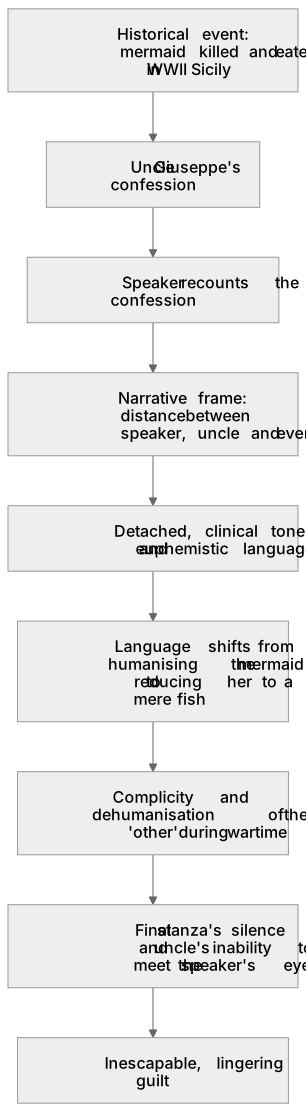
The poem explores the dark, magical realist tale of a captive mermaid being killed and eaten during World War II in Sicily. It examines themes of complicity, the dehumanisation of the 'other' during wartime, and the unreliability of narrative memory. The speaker recounts his uncle Giuseppe's confession, using detached, clinical language to contrast with the horrific, surreal events.
What earns the marks
- Analyse the use of magical realism, specifically the mermaid, as an allegorical figure representing wartime atrocities and the persecution of marginalised groups.
- Evaluate the effect of the detached, clinical tone and euphemistic language used by the perpetrators to justify their horrific actions.
- Discuss the significance of the narrative frame, focusing on the distance between the speaker, the uncle, and the historical event itself.
- Examine the structural choices, such as the use of free verse and irregular stanzas, to reflect the fragmented nature of guilt, trauma, and memory.
Common mistakes and how to put them right
Treating the poem as a literal historical account rather than recognising the mermaid as an allegorical figure for the 'other' and victims of war.
Ignoring the narrative framing; students often attribute the uncle's guilt directly to the speaker, missing the generational distance and inherited shame.
Overlooking the significance of the setting in World War II Sicily; failing to connect the starvation and desperation to the moral degradation depicted.
Exam tips
- Compare the theme of transgression and societal breakdown in 'Giuseppe' with other poems in the anthology, such as 'The Deliverer'.
- Focus closely on the transition of language from humanising the mermaid to reducing her to a mere fish to justify her murder.
- Use the final stanza's silence and the uncle's inability to look the speaker in the eye as key evidence of inescapable, lingering guilt.
Try the lesson
The start of the Component 3: Poetry – Section A: Post-2000 Poetry – Poems of the Decade: An Anthology of the Forward Books of Poetry 2002–2011: Giuseppe Roderick Ford lesson, made from checked teaching notes for this specification point.
Have a go first
In Roderick Ford's poem 'Giuseppe', what mythical creature is captured, killed, and eaten by the villagers?
Listen
The poem explores the dark, magical realist tale of a captive mermaid being killed and eaten during World War II in Sicily. It examines themes of complicity, the dehumanisation of the 'other' during wartime, and the unreliability of narrative memory. The speaker recounts his uncle Giuseppe's confession, using detached, clinical language to contrast with the horrific, surreal events. A strong answer earns marks for these points. Analyse the use of magical realism, specifically the mermaid, as an allegorical figure representing wartime atrocities and the persecution of marginalised groups. Evaluate the effect of the detached, clinical tone and euphemistic language used by the perpetrators to justify their horrific actions. Discuss the significance of the narrative frame, focusing on the distance between the speaker, the uncle, and the historical event itself. Examine the structural choices, such as the use of free verse and irregular stanzas, to reflect the fragmented nature of guilt, trauma, and memory. Exam tip: Compare the theme of transgression and societal breakdown in 'Giuseppe' with other poems in the anthology, such as 'The Deliverer'.
See it
Key words
Say what each word means before you turn the card.
Dehumanisation and the 'Other'
Try answering aloud or in your head before turning the card.
Guilt and Complicity
Try answering aloud or in your head before turning the card.
War and Morality
Try answering aloud or in your head before turning the card.
Memory and Storytelling
Try answering aloud or in your head before turning the card.
See every definition
- Dehumanisation and the 'Other'
- The reduction of a captive mermaid, an allegorical figure for marginalised groups, to a mere fish to justify her murder during wartime.
- Guilt and Complicity
- The uncle's confession of a horrific act, framed by the speaker's distance from the historical event and the inherited shame it carries.
- War and Morality
- The moral compromises made under the guise of necessity, set against starvation and desperation in World War II Sicily.
- Memory and Storytelling
- The unreliable narrative memory through which the speaker recounts his uncle Giuseppe's confession, using detached, clinical language.
Label the diagram
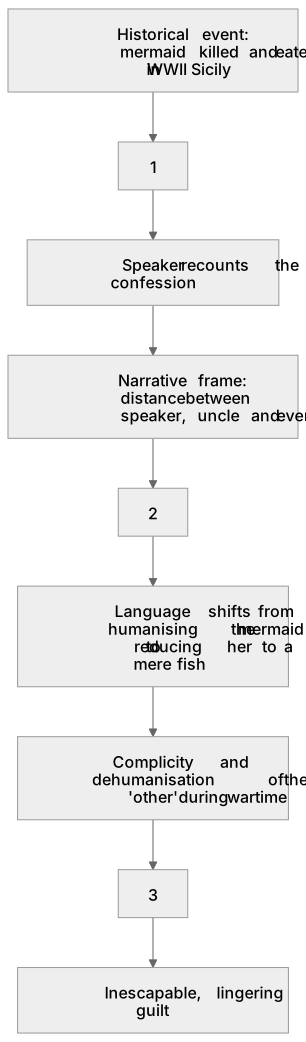
Some boxes have lost their names. Pick the right name for each number.
1Box 1
2Box 2
3Box 3
There is more to this lesson
The full lesson goes on to check your understanding and help you earn the marks. Create a free account to carry on, with your progress saved.
A week of Premium from your first lesson · Then the free plan continues · No card, no charge
Test your understanding of Component 3: Poetry – Section A: Post-2000 Poetry – Poems of the Decade: An Anthology of the Forward Books of Poetry 2002–2011: Giuseppe Roderick Ford
Active recall beats re-reading. Take an instant quiz now to test what you’ve learned and lock it into long-term memory.
A week of Premium from your first lesson · Then the free plan continues · No card, no charge